

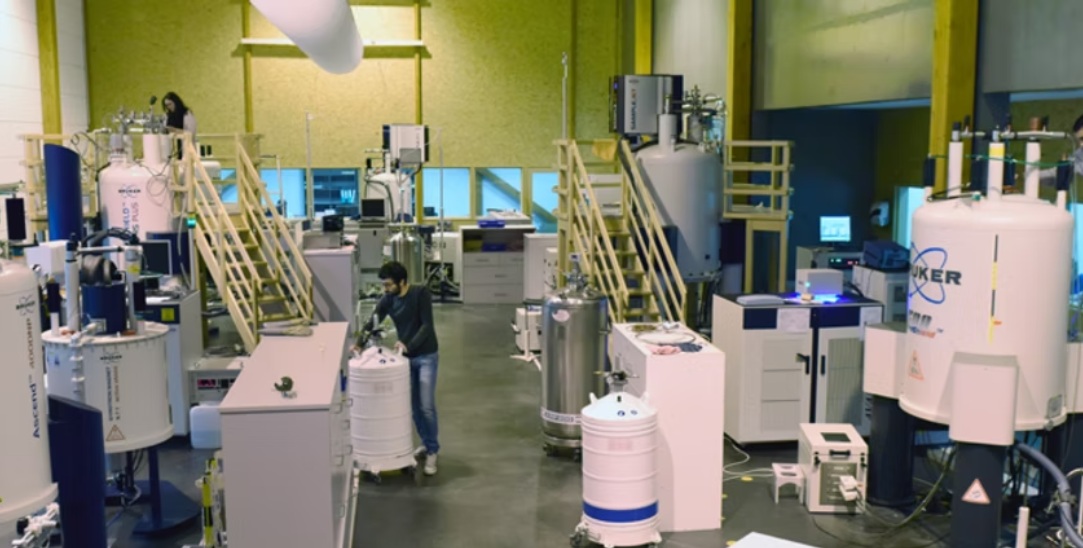
Image source: Centre de Résonance Magnétique Nucléaire, Lyon. Retrieved from the CRMN official website (CRMN | Home)
MR LATVIA is pleased to share a detailed update on the international research activities of PhD students Kristīne Senkāne and Alvis Zvirgzdiņš, who are currently conducting high-field solid-state NMR studies at the Centre de Résonance Magnétique Nucléaire (CRMN) in Lyon, France. Their secondments are supported by the MR LATVIA Early-Stage Researcher (ESR) mobility initiative, which has been specifically established to cultivate advanced technical competencies, promote scientific excellence, and strengthen collaborative links between Latvian research institutions and leading European NMR facilities.
Advancing Molecular-Level Insight into Biomaterials: Work by Kristīne Senkāne
As of early October, Kristīne has embarked upon an intensive two-month research placement that directly supports the core objectives of her doctoral project, which seeks to elucidate the molecular origins of the exceptional mechanical properties exhibited by spider silk hydrogels. These materials combine elasticity, robustness, and high water content in a manner that remains scientifically intriguing and technologically promising.
During her stay at CRMN, Kristīne has been engaged in a comprehensive programme of high-field solid-state NMR backbone and side-chain assignment experiments, employing a suite of four to six NH and CH based measurements at 110 kHz MAS using 0.7 mm rotors on 800 MHz and 1 GHz spectrometers. Concurrently, she has focused on developing essential practical skills that facilitate reliable high-resolution data collection, including:
- Gaining proficiency in 1.3 mm and 0.7 mm rotor packing, supported by the design and 3D printing of in-house sample-handling tools
- Executing probe installation procedures, enhancing her autonomy in configuring complex instrumentation
- Acquiring preliminary NMR data on spidroin hydrogels to evaluate sample integrity and optimize preparation strategies
- Managing day-to-day operational challenges associated with solid-state NMR, including performance tuning and troubleshooting that require patience, adaptability, and technical precision
Her growing expertise reinforces MR LATVIA’s capability to carry out sophisticated structural investigations while establishing a robust methodological foundation for future stages of the project.
Strengthening High-Field Experimental Capability: Progress by Alvis Zvirgzdiņš
Alvis has recently completed the first phase of his two-stage secondment, during which he has achieved substantial technical development across several operational aspects of high-field NMR experimentation. These advancements are expected to directly increase the instrumental readiness and experimental range available upon his return to Latvia.
Key accomplishments include:
- Successful execution of 100 kHz MAS measurements under demanding high-speed spinning conditions
- Advancement of sample preparation expertise, specifically related to the correct packing, balancing, and handling of 0.7 mm and 1.3 mm rotors, which is essential to ensure the integrity of fast-spinning experiments
- Active involvement in the maintenance, repair, and optimization of DNP probe hardware, allowing him to deepen his understanding of performance-limiting factors and operational safeguards associated with cutting-edge NMR technologies
- Participation in several doctoral thesis defenses, providing insights into international academic standards, professional presentation techniques, and the articulation of advanced scientific concepts
This combination of practical instrumentation work and scientific engagement has proven highly beneficial for developing his professional competence within the field of solid-state NMR.
Strategic Outcomes for Latvian NMR Research
The impressive progress demonstrated by both researchers highlights the critical value of immersive training in world-class laboratory environments. Their achievements contribute directly to their ongoing PhD projects while also advancing the broader mission of MR LATVIA to establish a sustainable national platform for high-field solid-state NMR research. The skills, expertise, and networks they are cultivating will continue to support Latvian scientific capacity long after these placements are completed.
MR LATVIA commends Kristīne and Alvis for their outstanding commitment and performance to date and expresses continued appreciation to CRMN Lyon for its collaboration, mentorship, and support. Further scientific outputs are anticipated as both research projects progress through their next experimental milestones.
Funded by the HORIZON-WIDERA-2023-ACCESS-02 programme, this initiative aims to strengthen research capacities and scientific excellence across Europe.